How Can AI Help Cities Like London and Their Councils?
London has moved from debating AI to deploying it. A briefing on where the 32 boroughs already use it, what City Hall's £30m package funds, and what councils, SMEs and partners can do in the next 90 days.

I. Nine Million Reasons to Get This Right
In 2026, London stopped debating AI and started deploying it. In the space of six months, City Hall convened a Taskforce, committed £30m, and began writing the rules for how artificial intelligence enters the capital's town halls, high streets and homes. The boroughs were already ahead of it.
The pressure points are real, and they are human. They take the form of backlogs, unread case files, missed early warnings, small businesses priced out of the future and workers who suspect, rightly or wrongly, that the future is being decided without them. AI can deepen those divides. It can also close them. Which of the two it does is not a question of code. It is a question of choices, made by councils, mayors, founders and citizens.
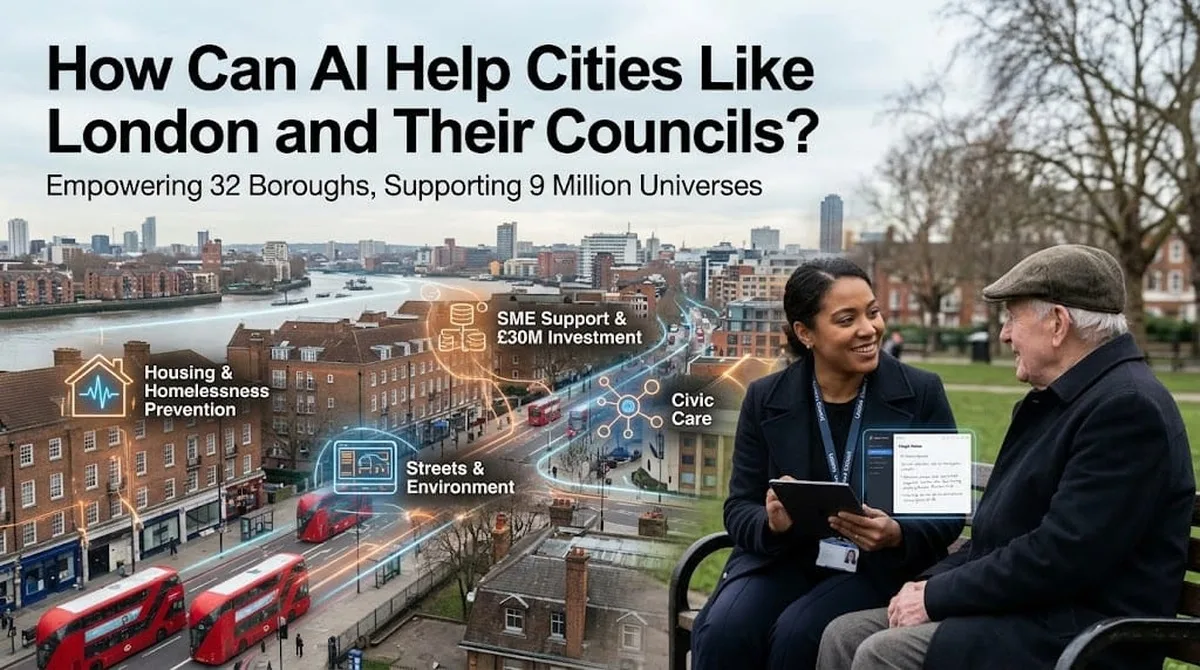
My thesis, across every book and platform I have built since 2011, is simple: each human being is humanity. A city is not an aggregate of datasets. It is nine million universes sharing one river. When an algorithm helps a social worker in Kingston spend more time with an elderly resident and less time typing, it is not "optimising a workflow". It is returning an hour of human presence to a human life. That is the measure that matters.
This article follows the research into three arenas where London is now acting:
The boroughs — how London's 32 boroughs and the City of London use AI to cut administrative burden, target social care, and manage infrastructure on tight budgets.
City Hall — what Mayor Sadiq Khan and the London AI and Jobs Taskforce are doing for AI literacy, small businesses and young people, under a £30m package.
The ecosystem — where businesses, universities, platforms and partners, including our own Citiesabc, Businessabc and AI ID Passport community, can join, build and lead.
It is written for leaders who do not want to watch the transformation from the pavement. It is an invitation as much as an analysis. The budgets are set, the programmes are live, and the partners are being chosen now. The question for every reader is simple: will you be a supplier to London's AI transition, a beneficiary of it, or a bystander?
II. The Stakes in Numbers: Why London Cannot Wait
Vision opens the door. Data tells us how wide it is. Before any partnership or pitch, every leader in this ecosystem should know the following figures by heart.
| Indicator | Figure | Source |
|---|---|---|
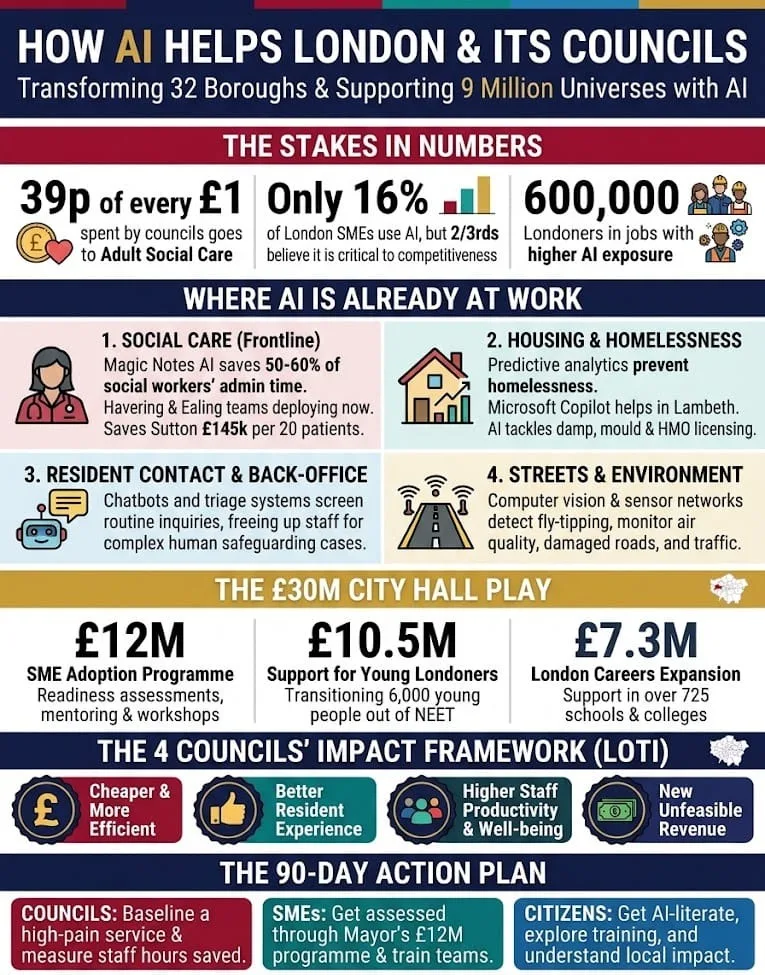
| Londoners in jobs with higher AI exposure and lower capacity to adapt | ~600,000 | Mayor of London, Jul 2026 |
| Share of London employment in high-exposure jobs with above-average capacity to adapt | Just over half | Mayor of London, Jul 2026 |
| London SMEs currently using AI in operations | 16% (fewer than 1 in 6) | Mayor of London, Jun 2026 |
| SMEs that believe AI will be critical to competitiveness within five years | Nearly two-thirds | Mayor of London, Jun 2026 |
| London workers expecting AI to affect their job soon (City Hall polling) | 56% | TechRepublic, Jan 2026 |
| Of every £1 councils spend, share going to adult social care | 39p | mySociety, Jul 2026 |
| Councils trialling or deploying AI tools (LGA, June 2025) | 70%+ | LB Hammersmith & Fulham, Nov 2025 |
Read these numbers together and a single story emerges. The exposure is concentrated, not universal. City Hall's Taskforce found that the 600,000 most vulnerable workers sit mainly in clerical and administrative roles, are disproportionately women, and tend to earn below the London average. The jobs at risk are the first rungs of the ladder.
Meanwhile, the businesses that employ more than half of London's workforce, its roughly one million SMEs, are mostly standing at the door of AI rather than walking through it. Nearly two-thirds believe it will decide their competitiveness; only one in six is using it. That gap between belief and action is the single largest commercial opportunity in the capital's AI economy.
And the councils, holding the welfare of the most vulnerable residents, spend almost two-fifths of every pound on adult social care. When demand grows and funding does not, AI is no longer a curiosity. It is a survival strategy.
Executive takeaway: London's AI challenge is not a technology gap. It is an adoption, literacy and trust gap. Whoever closes it, ethically and at scale, will shape the next decade of the city's economy.
III. Inside the Boroughs: Where AI Is Already Earning Its Place
London's local government is not waiting for permission. A 2025 survey reported by mySociety and Birkbeck placed London's councils at the top of the UK's AI innovators, alongside Scotland. The coordinating engine is the London Office of Technology and Innovation (LOTI), whose AI Network brings together more than 200 officers from London boroughs, with a Generative AI Adoption Working Group meeting monthly.
LOTI frames the value of AI in councils through four uses: cheaper and more efficient ways of working; a better resident experience; higher staff productivity, wellbeing and accessibility; and new revenue that was previously unfeasible. Every supplier and partner should learn this framework, because it is the language in which council business cases are written.
1. Social care: giving time back to the frontline
Adult social care is London's most popular area for AI, particularly AI note-taking and minute-taking, according to mySociety's borough mapping. The results are concrete:
Kingston — social workers using the Magic Notes AI tool reported a 50–60% reduction in time spent on case notes and assessments, according to the LGA case study.
Ealing — Magic Notes has been rolled out to more than 100 social workers across adult care teams, with a pilot beginning in children's services (Social Work Today).
Sutton — reported annual savings of £145,000 per 20 patients through reduced domiciliary care needs (LOTI).
Havering — staff for whom English is a second language reported more accurate, timely written notes (Havering scrutiny presentation).
The business lesson: the fastest wins are rarely glamorous. They sit in documentation, assessment and the hours lost between a conversation and a case record.
2. Housing and homelessness prevention
Housing is London's second most common AI use area, covering damp and mould, HMO licensing, rent and complaints. Lambeth, a borough of more than 325,000 residents, is combining generative AI pilots such as Microsoft Copilot with predictive analytics that support prevention in homelessness (The MJ). LOTI has also published research, with Faculty and six member councils, on how AI should be approached in adult social care and housing.
3. Resident contact and the back office
AI chatbots for citizen contact and translation rank next, followed by back-office automation. Triage tools that screen enquiries, Freedom of Information requests and routine questions free officers for complex, human cases such as safeguarding.
4. Streets, environment and planning
Computer vision and sensor networks help detect fly-tipping, monitor air quality and traffic, and flag damaged roads. Generative and spatial tools help officers parse dense planning applications and model local needs. LOTI's newest work, on agentic AI in council services, signals where the next wave is heading: systems that do not just answer, but act.
Executive takeaway: London's councils buy outcomes, not algorithms. Proposals that start from a measured problem — hours saved, cases prevented, pounds released — will win. Proposals that start from the technology will not.
IV. City Hall's Play: A £30m Bet That the Future of Work Can Be Shaped
On 15 January 2026, at the annual Mansion House dinner, Mayor Sadiq Khan warned that AI could become "a weapon of mass destruction of jobs" if leaders failed to act. He argued that London sits at the sharpest edge of change because of its reliance on finance, professional services and the creative industries. In the same speech he announced two things: a London taskforce on AI and the future of work, and free AI training for Londoners.
Six months later, the rhetoric had become a programme.
The Taskforce
On 28 April 2026, the Mayor appointed Baroness Martha Lane-Fox, co-founder of lastminute.com and a former UK digital champion, to chair the London AI and Jobs Taskforce. Its deputy chair is Anna Thomas MBE of the Institute for the Future of Work. Members named in City Hall's release include Professor John Amaechi OBE, Angie Ma of Faculty, and Adam Cantwell-Corn of the TUC.
After three months of work with employers, unions, educators and Londoners, the Taskforce reported on 21 July 2026. Its headline conclusion: an AI "jobs apocalypse" is not inevitable, but London must act early. The Mayor accepted every recommendation.
Three capabilities London is building
Act Early — a London AI Early Action System combining labour market data, employer insight and local evidence into an early-warning system for AI-driven change.
Shape Change — a London AI at Work Partnership, in which employers, workers and educators redesign work together rather than simply automating existing jobs.
Create Opportunity — a London Future Ready Guarantee, bringing employers and young Londoners together to co-design new jobs, skills and career pathways, with a focus on human skills such as judgement, communication and collaboration.
Where the £30m goes
| Commitment | Amount | What it funds |
|---|---|---|
| AI Adoption Programme for SMEs (via London & Partners) | £12m over 3 years | AI readiness assessments, expert mentoring, workshops, tailored guidance |
| Support for Young Londoners extension | £10.5m | Two more years of support for around 6,000 young Londoners not in education, employment or training |
| London Careers Programme expansion | £7.3m | Careers support in around 725 secondary and post-16 institutions |
| Total | ~£30m | The £18m youth package plus the £12m SME programme |
City Hall has also asked national government to discuss devolving more AI transition powers to London, including skills commissioning flexibility, AI Transition Incentives for employers, and wider fiscal flexibility. Business group BusinessLDN has called for a real-time AI and labour market insights dashboard, faster AI adoption across City Hall and public services, and a London-wide AI capability campaign.
Executive takeaway: London now has a policy architecture for AI and work. Each of its three pillars — early warning, work redesign and youth opportunity — needs employers, data partners, trainers and platforms to make it real. That is where business enters the story.
V. The SME Opportunity: One Million Businesses at the Door
The most important number in London's AI economy may be the smallest: 16%. That is the share of SMEs using AI in their operations today, according to government research cited by City Hall. Yet nearly two-thirds believe AI will be critical to their competitiveness within five years. In that gap lie lost productivity, lost exports and lost jobs. It is also where the next generation of London's growth will be won.
The Mayor's answer is a £12m AI Adoption Programme, announced at London Tech Week on 8 June 2026 and delivered over three years (£4m a year) by the growth agency London & Partners, designed in consultation with the Taskforce. It targets a market of roughly one million SMEs that together employ more than half of London's workforce.
What the programme offers
AI readiness assessments — a structured view of where a business stands today.
Expert mentoring — one-to-one guidance from practitioners.
Workshops and peer learning — owners learning from owners, not just from vendors.
Tailored guidance — matched to sector, size and maturity.
Notice what is not on the list: software licences. The programme funds the scaffolding that allows AI to be adopted well — diagnosis, confidence and capability. That is a deliberate and intelligent choice. Most small firms do not fail at AI because they lack tools. They fail because they lack a map.
Why it matters commercially
For technology providers, consultancies, trainers, media platforms and business networks, the programme does three things:
It creates demand. Thousands of SMEs will leave a readiness assessment with a list of priorities and a budget conversation to have.
It sets a standard. "AI-ready" is becoming a recognised business status in London. Those who can evidence it — through assessment, certification and visibility — will be trusted first.
It rewards ecosystems over point solutions. An SME does not want ten vendors. It wants a trusted guide that connects readiness, skills, tools and visibility in one journey.
This is precisely the space our ecosystem has served since 2011. Businessabc.net covered the £12m announcement the week it launched, because our community of founders and SMEs needs to know where the help is — and how to use it.
Executive takeaway: For every SME owner reading this: the support is funded and live. Get assessed, get mentored, and get your team literate. For every partner: the winners will be those who help SMEs move from assessment to action — and can prove the outcome.
VI. AI Literacy for Every Londoner: The New Civic Right
In the twentieth century, a city's strength was measured by its literacy rate. In the twenty-first, it will be measured by its AI literacy rate. A resident who cannot question an algorithm cannot fully participate in a democracy that increasingly runs on them. A worker who cannot direct an AI assistant will soon compete against one who can.
City Hall has understood this. At Mansion House in January, the Mayor promised an AI skills course available to any Londoner who wants it, completely free, because "everyone should be able to share in the benefits" (Computer Weekly). In July, accepting the Taskforce report, he committed to expanding AI training for Londoners.
The literacy stack London is assembling
Foundational AI training for all — everyday confidence, safe use and critical thinking for every resident.
Skills Bootcamps for Londoners — free, intensive courses for adults in AI, digital and creative tech, linked to job interviews.
Employer-led credentials — through the Local Skills Improvement Plan, BusinessLDN and partners are pushing for shorter, modular, stackable AI credentials built around real employer needs.
Inclusive talent focus — targeting groups most at risk of being left behind: older workers, disabled Londoners and under-represented communities.
Youth pathways — the £18m package, the Future Ready Guarantee and careers support in around 725 schools and colleges.
Public awareness — a London-wide AI capability and trust campaign to help residents use AI safely in daily life.
The missing piece: proof
Training without verification is a promise without a receipt. Employers cannot hire on attendance certificates. Councils cannot commission against vague completion rates. Individuals — particularly the 600,000 Londoners in the most exposed roles, who are disproportionately women and lower paid — need a portable, trusted record of what they can now do.
That is why we built the AI ID Passport through Businessabc Academy: a blockchain-verified, gamified AI literacy certification. It rests on a 10-domain AI Readiness Wheel and five progressive certification tiers, from foundational confidence to advanced leadership. It was designed for the same six audiences London now needs to reach — governments, universities, corporations, educational organisations, schools, and disabled and underserved communities.
The point is not to replace City Hall's training. It is to make every hour of that training count, visibly and verifiably, for the learner and for the employer.
Executive takeaway: AI literacy is becoming London's new civic infrastructure. Councils, employers and training providers should design for three outcomes at once — confidence, capability and credentials — or risk funding courses that leave no trace.
VII. Trust Is the Real Infrastructure
Every AI system in a council touches someone's life. A housing algorithm can decide who gets an early visit. A triage model can decide which complaint is read first. A care-notes tool shapes the record a family may one day read. In public services, efficiency without trust is not progress. It is a liability waiting to surface.
London's sector knows this, and the governance conversation is maturing fast.
Four tests every public-sector AI deployment must pass
| Test | The question | What good looks like |
|---|---|---|
| Fairness | Could this disadvantage a specific community? | Algorithms in housing and social care are audited for bias before and after deployment (LGA AI Hub) |
| Human oversight | Who makes the final decision? | AI assists officers; accountable humans decide on vulnerable residents' welfare |
| Transparency | Can residents see what is being used, and why? | Public registers, oversight boards and co-designed data charters |
| Value | Did it actually work? | A cost baseline before deployment and measured outcomes after |
London's emerging good practice
Transparency mapping. mySociety and Birkbeck have mapped how openly London boroughs disclose their AI use, including which councils have formal AI oversight boards. Their finding is a challenge to the sector: adoption is moving faster than disclosure.
Co-designed data charters. Camden co-created a Data Charter with residents to make data use, including AI, clear and accessible (Local Government Lawyer).
Baselining before buying. LOTI argues that councils often fail to measure efficiencies from new technology, so savings are hard to attribute and benefits are justified after the fact. Knowing the true cost of each service first is what turns an AI pilot into an investment case.
Responsible AI networks. LOTI's Responsible AI programme shares lessons across boroughs, including machine learning for homelessness interventions and use-case design templates.
What this means for partners
For businesses selling into London's public sector, governance is not a compliance appendix. It is the product. Councils will increasingly buy from partners who arrive with:
A measured baseline and an agreed definition of success.
Bias and impact assessments that can survive public scrutiny.
Clear human-in-the-loop design for any decision affecting residents.
Workforce training so staff use AI as an assistant, not a replacement for judgement.
Executive takeaway: In London, the licence to operate in AI is earned in public. The partners who treat transparency, fairness and measurable value as features — not friction — will be the ones still trusted in five years.
VIII. Your 90-Day Action Agenda
Insight without action is just commentary. Here is what each group in London's AI ecosystem can do in the next 90 days.
| If you are… | Do this now | Measure this |
|---|---|---|
| A council leader or chief executive | Pick one high-volume, high-pain service (case notes, housing triage, resident contact). Baseline its cost per case before choosing any tool. Join LOTI's AI Network if you have not. | Staff hours released; cost per case; resident satisfaction |
| A council digital or data lead | Publish what AI you use, why and with what safeguards. Set up or strengthen an AI oversight board. Pair every deployment with staff training. | Public disclosure in place; bias assessments completed; staff trained |
| An SME owner or founder | Apply for the Mayor's AI Adoption Programme through London & Partners. Get an AI readiness assessment. Certify at least one team member in AI literacy. | AI use cases live; hours saved per week; staff certified |
| An employer with exposed roles | Map which clerical and administrative tasks AI will change. Redesign roles with your workers, not around them. Fund verified upskilling. | Roles redesigned; internal moves vs redundancies; credentials earned |
| A university, college or training provider | Build short, modular, stackable AI credentials with employers. Align with the Local Skills Improvement Plan and Skills Bootcamps. | Completion-to-job rates; employer recognition of credentials |
| A funder, foundation or corporate sponsor | Back AI literacy for the groups most at risk: women in administrative roles, older workers, disabled Londoners, young people not in work or education. | Learners reached; progression into better work |
| A Londoner | Take a free AI course. Use AI on one real task this week. Ask your council and employer how they use AI with your data. | Confidence, capability, and a credential you can show |
The common thread is simple: start small, measure honestly, scale what works, and keep people at the centre. That is how London turns a £30m policy commitment into a decade of shared prosperity.
IX. The Choice in Front of London
So, how can AI help cities like London and their councils? The evidence is now clear.
It can give time back — 50 to 60% of the hours social workers spend on notes in Kingston, returned to people who need care. It can see trouble earlier — a family drifting towards homelessness, a road about to fail, a job category about to change. It can open doors for small businesses that have never had a data team, a strategist or a mentor. And it can make every Londoner more capable, if literacy is treated as a right rather than a privilege.
None of that happens automatically. The same tools that release hours can also erode trust. The same automation that lifts productivity can quietly remove the first rung of the career ladder for 600,000 people. The difference lies in who is at the table when the systems are designed, funded and measured.
London has made its opening move: a Taskforce, a policy architecture, £30m on the table and 32 boroughs already learning by doing. The next move belongs to the rest of us — the founders, the employers, the educators, the platforms and the citizens.
Every resident who gains confidence with AI makes the whole city stronger. Every SME that crosses the adoption gap creates jobs others can grow into. Every council that deploys AI transparently builds trust for the next one. This is what it means to say that each human being is humanity: a city rises person by person, or not at all.
X. Final Notes: How Cities Can Learn to Stop Worrying and Live with AI
In 1964, Stanley Kubrick released Dr. Strangelove or: How I Learned to Stop Worrying and Love the Bomb. It is a black comedy about the most dangerous technology of its age. Its subtitle has become shorthand for a mood every city leader will recognise: the urge to swing between panic and surrender.
It is no accident that the Mayor of London reached for Cold War language in January, warning that AI could become a weapon of mass destruction of jobs. The comparison is useful — but not because AI is a bomb. It is useful because Kubrick's film is a precise study of how institutions fail when a powerful technology outruns their governance. Each of those failures offers a lesson for a modern city.
Four lessons from the War Room
| In the film | The failure | The lesson for cities |
|---|---|---|
| A single general launches an attack, and only he holds the code to recall it | Power and knowledge concentrated in one pair of hands | Spread AI literacy across the workforce and the public. No council should depend on one supplier, one team or one expert who alone understands its systems |
| A "Doomsday Machine" is built to respond automatically, with no way to switch it off | Automation without a human override | Keep accountable humans in the loop for every decision about residents' lives, and design every system so it can be paused, audited and stopped |
| The machine is kept secret, so it cannot even serve its purpose of deterrence | Opacity destroys trust and value | Publish what AI you use, why, and how it is governed. Transparency is not a risk to public AI; it is what makes it work |
| Leaders improvise in a crisis they never planned for | Reacting late instead of preparing early | Build early-warning systems now — exactly what London's Taskforce has proposed with its AI Early Action System |
Why every city must take AI seriously
The bomb was a technology the world had to contain. AI is different: it is a technology cities have to live with, every day, in every service. It will not be un-invented. Residents are already using it on their phones. Businesses are already competing with it. Neighbouring cities are already deploying it. A city that chooses not to engage has not avoided a decision. It has handed that decision to others.
Three reasons make this urgent for every city, not only London:
Budgets. Demand for social care, housing and public services is rising faster than funding. Measured, responsible AI is one of the few levers that can release capacity at scale.
Competitiveness. Cities that help their small businesses adopt AI will keep and create jobs. Those that do not will watch both move elsewhere.
Fairness. If AI literacy is left to the market, the people most exposed to change — often lower-paid workers in administrative roles — will be the last to benefit and the first to lose.
The right way to stop worrying
The tragedy of Kubrick's characters is that they stop worrying for the wrong reasons: through fatalism, blind faith in machines and a refusal to ask hard questions. Cities need to stop worrying for the right reasons. That means replacing fear with literacy, secrecy with transparency, and blind automation with accountable design.
We should not love AI unconditionally. We should learn to live with it consciously — understanding it, governing it, measuring it, and putting it to work for people. In the film, nobody in the War Room could stop the machine they had built. London's opportunity, and that of every city, is to build the War Room the other way round: open, informed, plural, and with every citizen holding a share of the recall code.
Sources and References
City Hall and the London AI and Jobs Taskforce
Mayor backs £30m investment to help London shape the future of work — Mayor of London, 21 Jul 2026
Mayor unveils £12m AI support package for London's small businesses — Mayor of London, 8 Jun 2026
London AI and Jobs Taskforce: Shaping how AI changes work in London — Mayor of London
Preparing London for the future of AI and work — London Assembly paper
Mayor of London accepts all AI and Jobs Taskforce recommendations — Institute for the Future of Work
London Mayor launches £12m AI fund for small businesses — LocalGov, 8 Jun 2026
Mayor backs £30m AI skills package — Think Digital Partners, 22 Jul 2026
Mayor pushes AI skills drive to protect London jobs — TechRepublic, 16 Jan 2026
Senior business leaders unveil action plan to ensure AI is a win-win — BusinessLDN
New strategy set to tackle London's skills shortages amid rise of AI — BusinessLDN
Mayor and city leaders deliver plans to boost London's growth — London Councils, 2026
London's boroughs and local government AI
Baselining, the key to unlocking value in local government using AI — LOTI
AI in Local Government: London's innovative solutions — LOTI
Robots and councils: how is AI being used by local government? — mySociety and Birkbeck, 21 Jul 2026
Kingston Council: Using AI in Adult Social Care administration — LGA
Magic Notes overview and scrutiny presentation — LB Havering, Sep 2025
Councils' AI future — The MJ
Update on AI Governance and Adoption — LB Hammersmith & Fulham, Nov 2025
10 ways councils are using AI to transform public services — LocalGov
Enhancing UK citizen services through AI-driven automation — The Scale Factory
Ztudium ecosystem