AI Funding for Small Businesses: How London and Its Councils Are Backing AI Adoption
What London's £12m AI Adoption Programme covers, what it leaves out, and how small firms can fund AI tools and equipment, with lessons from the councils already using AI.

On this page

AI funding for small businesses in London now comes in two parts. First, there is free public support to help you decide what to do. Then there is ordinary business finance to pay for the tools. In 2026, City Hall put around £30m behind AI and jobs, and £12m of that goes to small firms. Meanwhile, the capital's councils are already using AI to save staff hours, which shows where the quick wins are.
This guide explains what the support covers, what it does not cover, and how to fund the rest. It also shows what councils have learned, because their lessons apply to any small business. If you already know what you need, you can compare UK business funding for it straight away.
Why AI matters for London's small businesses
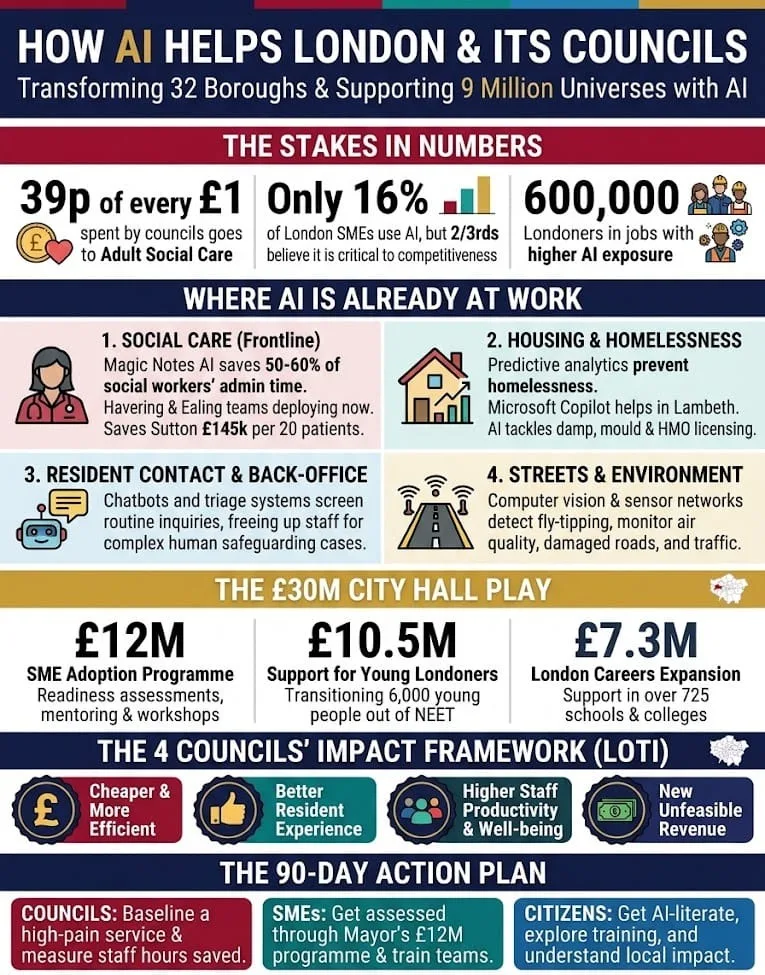
Small firms are the core of London's economy. Roughly one million SMEs employ more than half of the city's workforce. Yet most of them have not started with AI. According to City Hall, only 16% of London SMEs use AI in their operations. Even so, nearly two-thirds believe it will be critical to their competitiveness within five years.
That gap between belief and action is the real problem. It is also the opportunity. A firm that adopts AI well can free up hours, serve customers faster and compete with larger rivals. In contrast, a firm that waits may find its costs and its customers moving elsewhere.
The pressure is personal, too. City Hall's taskforce found that around 600,000 Londoners work in jobs with higher AI exposure and a lower capacity to adapt. Most of these are clerical and administrative roles. So the way small employers adopt AI will shape many careers, not just profits.
| Indicator | Figure | Source |
|---|---|---|
| London SMEs using AI in their operations | 16% | Mayor of London, Jun 2026 |
| SMEs that expect AI to be critical within five years | Nearly two-thirds | Mayor of London, Jun 2026 |
| Londoners in high-exposure jobs with lower capacity to adapt | ~600,000 | Mayor of London, Jul 2026 |
| London workers who expect AI to affect their job soon | 56% | TechRepublic, Jan 2026 |
| Share of every £1 councils spend on adult social care | 39p | mySociety, Jul 2026 |
The £12m AI Adoption Programme: support, not a cash grant
The Mayor announced the £12m AI Adoption Programme at London Tech Week on 8 June 2026. The growth agency London & Partners runs it over three years, at about £4m a year. City Hall designed it with its AI and jobs taskforce.
What the programme offers
AI readiness assessments — a clear view of where your business stands today.
Expert mentoring — one-to-one guidance from practitioners.
Workshops and peer learning — owners learning from other owners, not only from vendors.
Tailored guidance — advice matched to your sector, size and maturity.
What it does not pay for
Notice what is missing from that list: software licences. The programme pays for diagnosis, confidence and skills. It does not hand you money to buy tools. That is a sensible choice, because most small firms do not fail at AI for lack of tools. Instead, they fail for lack of a plan.
However, it means you still need a budget for the tools you choose. That is where the next step comes in.
AI funding for small businesses: how to pay for the tools
Once an assessment shows what you need, the cost usually falls into one of three groups. Each one suits a different kind of AI funding for small businesses.
Software and subscriptions
Most AI tools are monthly subscriptions. For many firms, these come out of normal cash flow. Still, a larger rollout can add up quickly across a team. In that case, a short-term facility can smooth the cost while the savings arrive. You can compare business loans to see what a facility would cost in total.
Hardware and equipment
Some projects need physical kit, such as new computers, servers, sensors or connected machines. For these, asset finance spreads the cost over the life of the equipment. As a result, you keep cash in the business while the kit starts earning its keep.
Larger projects and grants
A bigger change, such as rebuilding a core process, may need a longer business loan. Before you borrow, though, check whether a grant fits your project. Our list of UK business grants tracks open programmes with their deadlines and sources. To see how we rank options, read how we compare.
Free training for your team
People are the other half of the cost. Fortunately, some of it is free. Skills Bootcamps for Londoners offer free, intensive courses in AI, digital and creative tech, linked to job interviews. In January, the Mayor also promised a free AI skills course for any Londoner who wants one.
City Hall's £30m plan for AI and jobs
The SME programme is part of a wider plan. On 15 January 2026, at the Mansion House dinner, Mayor Sadiq Khan warned that AI could become "a weapon of mass destruction of jobs" if leaders failed to act. In the same speech, he announced a taskforce on AI and work, plus free AI training for Londoners.
On 28 April 2026, the Mayor asked Baroness Martha Lane-Fox to chair the London AI and Jobs Taskforce. Anna Thomas MBE of the Institute for the Future of Work became deputy chair. The taskforce reported on 21 July 2026. Its main finding was that job losses are not inevitable, but London must act early. The Mayor then accepted every recommendation.
| Commitment | Amount | What it funds |
|---|---|---|
| AI Adoption Programme for SMEs (via London & Partners) | £12m over 3 years | Readiness assessments, mentoring, workshops and tailored guidance |
| Support for Young Londoners extension | £10.5m | Two more years of support for around 6,000 young Londoners not in education, employment or training |
| London Careers Programme expansion | £7.3m | Careers support in around 725 secondary and post-16 institutions |
| Total | ~£30m | The £18m youth package plus the £12m SME programme |
The taskforce also set out three goals. First, an early-warning system for AI-driven change in the labour market. Second, a partnership in which employers, workers and educators redesign jobs together. Third, a guarantee that brings employers and young Londoners together to create new jobs and career paths.
How London's councils already use AI
Councils face the same squeeze as small firms, only at a larger scale. They spend 39p of every £1 on adult social care, and demand keeps rising. So many of them now use AI to release staff time. The London Office of Technology and Innovation (LOTI) links more than 200 council officers through its AI network.
Social care. In Kingston, social workers using the Magic Notes tool reported a 50–60% cut in time spent on case notes and assessments, according to an LGA case study. Ealing has rolled the same tool out to more than 100 social workers.
Housing. Lambeth combines Microsoft Copilot pilots with predictive analytics that support homelessness prevention.
Resident contact. Chatbots and triage tools screen routine questions, so officers can focus on complex cases such as safeguarding.
Streets and environment. Cameras and sensors help councils spot fly-tipping, monitor air quality and traffic, and flag damaged roads.
Lessons for small businesses
The councils' results point to a simple rule: start with the dull work. The fastest wins sit in notes, forms and the hours between a conversation and a record. Most small firms have the same hidden cost in quotes, invoices and email.
Also, measure before you buy. LOTI argues that councils often fail to record what a task cost before new technology arrived. Without that baseline, nobody can prove the savings. The same is true for a lender or a grant panel, because a clear before-and-after figure makes any funding request stronger.
Selling AI to councils
Many London firms will also sell AI services to the public sector. For them, trust is part of the product. Councils increasingly look for partners who bring a measured baseline, bias checks, a human decision-maker for anything affecting residents, and staff training. Openness matters as well. For example, mySociety and Birkbeck have mapped how openly each borough discloses its AI use. If your business works with councils or advises SMEs, you can also partner with us.
A 90-day AI plan for your small business
Here is a practical way to start, step by step.
Pick one task. Choose a high-volume, low-joy job, such as quotes, bookkeeping or customer emails.
Measure it. Record how many hours it takes each week and what those hours cost.
Get assessed. Apply for the AI Adoption Programme through London & Partners and take the readiness assessment.
Train one person. Book a team member onto a free course, such as a Skills Bootcamp.
Price the tools. Cost the software and any equipment, then find your funding options if the budget falls short.
Check the result. After a month of use, compare the hours saved with your baseline. Then decide whether to scale up.
In short, AI funding for small businesses in London starts with free help and ends with a normal investment decision. The support covers the thinking. You cover the tools, ideally with a clear figure for what they will save. We explain how we stay independent, and how this site is paid for, on how we earn.
Questions about AI funding
Is there AI funding for small businesses in London?
Yes. City Hall's £12m AI Adoption Programme, run by London & Partners over three years, gives SMEs AI readiness assessments, expert mentoring, workshops and tailored guidance.
Does the £12m AI Adoption Programme pay for software?
No. It funds diagnosis, mentoring and skills rather than software licences, so the tools themselves come from your own budget or from business finance.
How can a small business pay for AI tools and equipment?
Subscriptions usually come from cash flow. Equipment such as computers, servers or sensors suits asset finance, and larger projects may need a business loan or a grant.
Is there free AI training in London?
Yes. Skills Bootcamps for Londoners offer free, intensive courses in AI, digital and creative tech, and the Mayor has promised a free AI skills course for any Londoner who wants one.
How are London's councils using AI?
Mainly to save staff time: note-taking in social care, predictive analytics for homelessness prevention, chatbots for routine questions, and sensors for fly-tipping, air quality and roads.